I Gave a Fruit Fly's Brain $500
Six days, 3,119 listings, 3,110 runs of a whole-brain simulation, 245 swaps in and out of the cabinet. Here is what a 127,000-neuron insect brain wants when you point it at eBay.
Write-Up
An experiment · September 17–22, 2026
I Gave a Fruit Fly's Brain $500 and Let It Shop for Ancient Coins
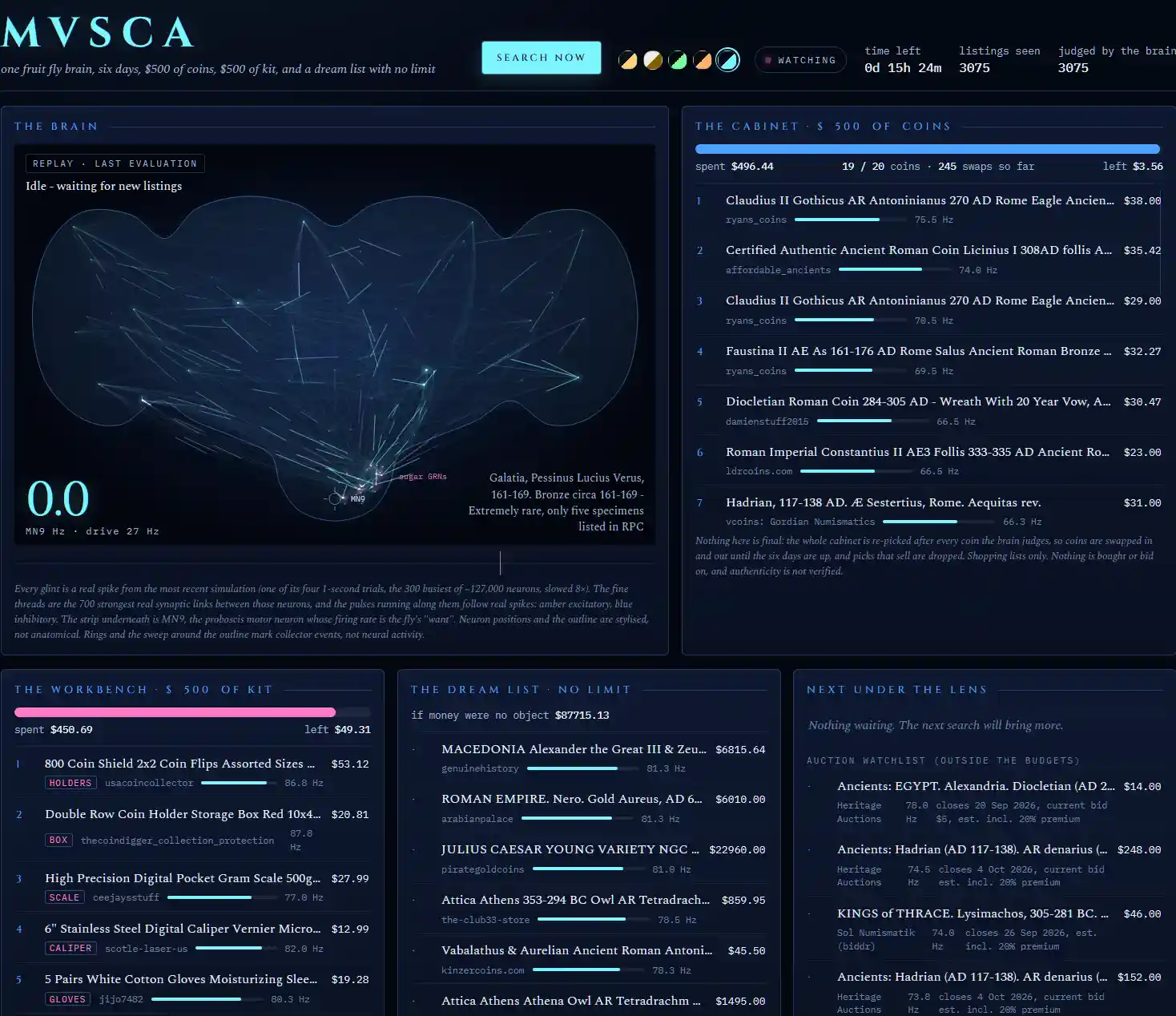
Over six days, a 127,000-neuron simulation of a fruit fly's brain judged 3,119 listings from eBay and 45 other websites. I wanted to see what an insect brain wants when you point it at eBay.
The idea
In 2024 scientists finished mapping every neuron (nerve cell) and every synapse (a point where two neurons connect) in an adult fruit fly's brain. The map is called the FlyWire connectome, and it covers about 139,000 neurons and 54 million synapses.
Alongside it, Shiu and colleagues turned an earlier (2023) version of the map into a model you can run on a computer (Shiu et al., Nature 2024). That version has about 127,000 neurons. It is a "leaky integrate-and-fire" model. Each neuron works like a leaky bucket: its inputs fill it with charge, the charge slowly leaks away, and when it reaches a threshold the neuron fires a spike.
In the model's best-known result, stimulating the fly's sugar-tasting neurons switches on a motor neuron (a neuron that drives a muscle). In a living fly, that neuron makes the fly stick out its proboscis (its feeding tube) to eat.
Earlier this year people started hooking that brain up to video games like Doom. They fed in the picture on screen and used the brain's output to move the player. I collect ancient Roman and Greek coins, so I wanted to try something more personal. What would the fly collect if I gave it my budget?
The rules I set for it:
$500 for coins, which I call the cabinet. Only ancient Roman or Greek coins, one coin per listing, at a fixed price (no auctions).
A separate $500 for equipment: flips (small coin holders), a storage box, a loupe (magnifier), a scale, calipers, gloves, a tray, a reference book and, with whatever money was left, a wooden coin cabinet with drawers.
A dream list with no budget, for whatever it wanted most if money were no object.
Six days to shop. It could swap coins in and out at any point, and nothing was final until the clock ran out.
It never buys anything. It makes a shopping list with links, and I do the buying if I agree with the fly.
How a fly shops
A fly can't read an eBay listing, so the process has a few steps. Only steps 3 and 4 are the brain. The rest is Claude and me.
Claude read the listings. Every three hours, this AI assistant opened eBay and five of the ancient coin dealers and auction houses I already buy from, a different five each time. From day five it also searched VCoins, a large marketplace for coin dealers. It saved what it found into a folder. It could only read pages, and it never logged in, bid or bought anything.
My rules scored the title. Each listing got a score from 0 to 1, based only on its title. The rules checked how well the title identified the coin: its ruler, mint (the city that made it), date, denomination (the type of coin, like a penny or a dime) and the design on the back. They checked how famous the ruler was, from Alexander the Great and Julius Caesar at the top to an obscure 4th-century Caesar near the bottom. Certified coins (checked and sealed by a grading company) scored higher. Gold beat silver, and silver beat bronze. Titles with words like replica, plated, lot (a bundle of coins), uncleaned (dirty coins sold in bulk) or jewelry were thrown out before the brain saw them. So were "grails" (famous, rare coins) priced too low to be genuine. Some of these rules came in partway through the run, after the mistakes I describe below.
The score became sugar. It set how hard I stimulated the 21 sugar-tasting neurons on the right side of the model's brain. A score of 0 meant 20 spikes per second, and a score of 1 meant 150. Then my desktop PC ran all 127,000 neurons for one simulated second, four times over. Each coin took about a minute.
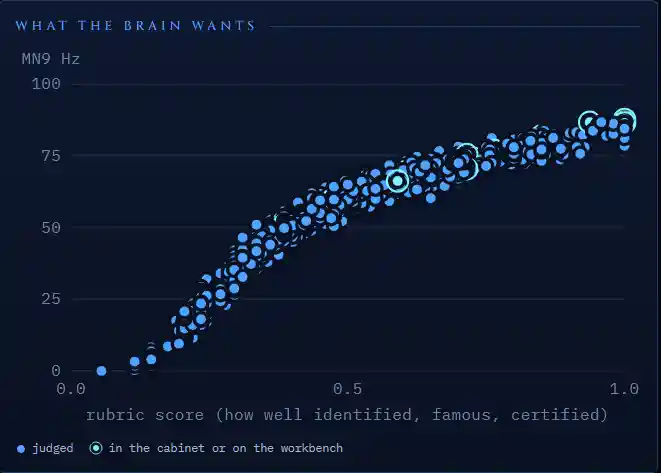
MN9 was the vote. I watched one neuron at the end of the chain, MN9, the motor neuron that sticks out the proboscis. How fast it fired, in Hz (spikes per second), is how much the fly "wants" the coin. I call that number the coin's want, and it's all I take from the brain.
The cabinet was rebuilt after every coin. A program picked the set of coins with the highest total want that fit in $500 (and, from day five, in the 20 slots my tray has). So a new coin could bump an old one out, and coins that sold were dropped and replaced.
The fly has no idea what a coin is. All the judging happens in step 2, in scoring rules I wrote. The brain model simulates the fly's wiring neuron by neuron, but here it acts like a dial: the higher the score, the faster MN9 fires, with some random noise. Across the 2,770 coin listings (the other 349 were equipment), a score of 0.15 gave about 4 Hz of want, 0.45 gave about 56 Hz and 0.82 gave about 76 Hz. The "fly brain plays Doom" demos work in a similar way. The brain decides how want rises with score (almost flat for low scores, steep in the middle, level at the top), and it adds some randomness. I still think that's interesting, even if the fly is no numismatist (coin expert).
What happened over six days
3,119 listings read (2,770 coins and 349 pieces of equipment)
3,119 brain simulations
46 websites that supplied listings
69 coins that spent time in the cabinet
225 times a coin moved in or out of the cabinet
209 auction lots watched (auction coins could only go on the dream list)
I only started logging cabinet moves on the first evening, so the true counts for the cabinet are a little higher.
eBay supplied about half the listings. VCoins came second once I added a search across all VCoins stores on day five.
Source | Listings |
|---|---|
eBay | 1,618 |
VCoins | 258 |
numiscorner.com | 67 |
mrbcoins.com | 65 |
nomosag.com | 51 |
gascogne-monnaie.com | 50 |
henzen.org | 50 |
numismall.com | 49 |
ldrcoins.com | 48 |
galata.co.uk | 46 |
I enjoyed watching the cabinet change over the six days. On the first evening it held a few pricier coins. There was a bronze coin of Helena (Constantine the Great's mother) at $44.87, a Trajan quadrans (a small bronze coin) at $48 and a coin of the emperor Aurelian at $51.85. Each of those was pushed out within hours. As the fly saw more listings, the program kept swapping one $50 coin for two or three $25 coins. The average price of a coin entering the cabinet fell almost every day:
Day | Average price | Times a coin entered |
|---|---|---|
1 (Sep 17) | $39.95 | 32 |
2 (Sep 18) | $32.70 | 41 |
3 (Sep 19) | $32.76 | 3 |
4 (Sep 20) | $30.27 | 13 |
5 (Sep 21) | $28.82 | 12 |
6 (Sep 22) | $27.44 | 14 |
By the end the cabinet held 19 coins for $496.44, and the most expensive one cost $38.00. With a fixed budget, the fly ends up acting like a bargain hunter. Several cheap coins add up to more want than one expensive coin.
Some coins stuck. The $28 Galerius antoninianus (a Roman coin of the 200s AD) came in on the first evening at 8:25 pm. It was pushed out twice but came back both times, and it was still there at the end. A Diocletian follis (a Roman bronze coin) with a twenty-year vow wreath on the back arrived at half past midnight on day two and stayed to the end. Others lasted minutes. A bronze coin of Trajan (an "as") showing the goddess Victory was in the cabinet for six minutes before two coins of the emperor Probus replaced it.
The first thing that went wrong was replicas. On day one, a listing called "Ancient Roman Marcus Aurelius Aureus 168 AD Rome Gold Plated Coin Cufflinks" got a want of 73.8 Hz. It sat in the cabinet for 44 seconds before I banned the word "plated". Then a $32 "Head of Alexander the Great - Dekadrachm" sat there for almost three days before I noticed. A dekadrachm is a large Greek silver coin, and a genuine one would cost many thousands of dollars. The scoring rules only read titles, and a title can say anything. I added minimum prices: no dekadrachm under $500, no gold under $250, and no tetradrachm (a Greek silver coin equal to four drachms) under $50, except the common Egyptian kind. The two rule changes threw out 14 listings it had already accepted.
The second problem was time. I lost about 17 hours on days three and four to an accidental stop and a reboot. That's why those days have fewer brain runs, though no data was lost.
The final cabinet
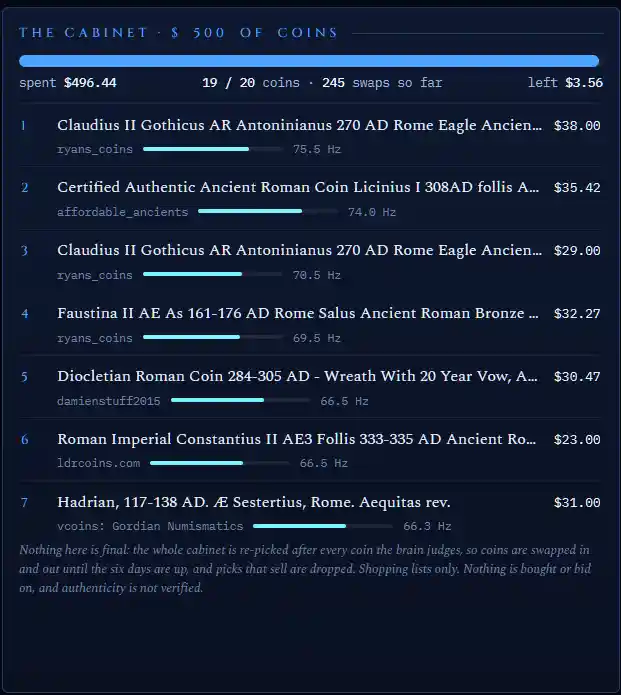
The final cabinet held 19 coins for $496.44 of the $500. The program picked them because, together, they had the most want that fit in the budget. In the table, "score" is what my rules gave the title (from 0 to 1), and "want" is how fast MN9 fired (in Hz). Prices include shipping. Where a listing didn't show a shipping cost, I added an estimate.
# | Coin | Seller | Price | Score | Want | Source |
|---|---|---|---|---|---|---|
1 | Claudius II Gothicus AR Antoninianus 270 AD Rome Eagle Ancient Roman Silver Coin | ryans_coins | $38.00 | 0.71 | 75.5 Hz | eBay |
2 | Certified Authentic Ancient Roman Coin Licinius I 308AD follis Antioch Jupiter | affordable_ancients | $35.42 | 0.73 | 74.0 Hz | eBay |
3 | Claudius II Gothicus AR Antoninianus 270 AD Rome Eagle Ancient Roman Silver Coin | ryans_coins | $29.00 | 0.71 | 70.5 Hz | eBay |
4 | Faustina II AE As 161-176 AD Rome Salus Ancient Roman Bronze Coin | ryans_coins | $32.27 | 0.60 | 69.5 Hz | eBay |
5 | Diocletian Roman Coin 284-305 AD - Wreath With 20 Year Vow, AE Follis, 20mm R90 | damienstuff2015 | $30.47 | 0.54 | 66.5 Hz | eBay |
6 | ldrcoins.com | $23.00 | 0.60 | 66.5 Hz | ldrcoins.com | |
7 | Gordian Numismatics | $31.00 | 0.59 | 66.2 Hz | VCoins | |
8 | goldenruleenterprises.org | $33.00 | 0.54 | 66.0 Hz | goldenruleenterprises.org | |
9 | Roman circa 330 AD, Constantine I bronze coin, certified slab. C012 | mastodonia | $23.36 | 0.54 | 64.5 Hz | eBay |
10 | 321 Constantine II AE3 Roman Empire Vot X Siscia Mint VF (24121604R) | cgcoins.com | $25.00 | 0.57 | 63.0 Hz | cgcoins.com |
11 | goldenruleenterprises.org | $28.00 | 0.51 | 62.8 Hz | goldenruleenterprises.org | |
12 | Constantine the Great 307-337, AE Follis (18 mm, 2.69 gram) Ticinum 322-325 | Gert Boersema | $29.24 | 0.47 | 60.2 Hz | VCoins |
13 | Ancient Roman Bronze Coin Constantine Imperial Camp Gate Follis AE3 324AD 2.15g | tquin | $26.00 | 0.47 | 56.8 Hz | eBay |
14 | Galerius AR Antoninianus 284-294 AD Cyzicus Jupiter Ancient Roman Silver Coin | ryans_coins | $28.00 | 0.48 | 56.2 Hz | eBay |
15 | 198-217 Caracalla, AE19 Eastern Greek Imperial Tyche Turreted Bust (23121308R) | cgcoins.com | $19.99 | 0.45 | 54.5 Hz | cgcoins.com |
16 | forumancientcoins.com | $13.00 | 0.39 | 51.0 Hz | forumancientcoins.com | |
17 | forumancientcoins.com | $18.00 | 0.39 | 49.8 Hz | forumancientcoins.com | |
18 | curated_jericho | $10.69 | 0.39 | 48.0 Hz | eBay | |
19 | goldenruleenterprises.org | $23.00 | 0.38 | 47.2 Hz | goldenruleenterprises.org |


The fly built a cabinet of mostly third- and fourth-century Roman bronze and billon (low-grade silver) coins. The emperors are Claudius II, Aurelian, Diocletian, Galerius, Licinius, Constantine and his sons Constantine II and Constantius II, and Arcadius. That makes it a "Crisis and Dominate" collection, covering the empire's near-collapse (about 235-284 AD) and the all-powerful emperors who came after. Its older anchors are two second-century bronzes, a Hadrian sestertius and a Faustina II as. There is also a Caracalla coin made by a Greek-speaking city in the east, and two Herod Agrippa prutot (small bronze coins) from Judaea at $13 and $18.
Late Roman coins suit my scoring rules. Dealers describe them more fully than most, usually giving the ruler, date and type of coin, and often the mint and the design on the back. Most of the emperors are famous enough to score, and my rules even read "Claudius II" as the more famous Claudius. The coins are also cheap enough that nineteen of them fit into $500. The fly found coins with detailed titles and low prices. A collector on a budget does much the same thing, for much the same reasons.
The cabinet has no Greek silver, no Roman Republican denarius (a silver coin from before the emperors) and nothing older than 100 AD except the Judaean bronzes. Those coins were in the listings, but they lost on price. An Athenian owl (a large silver coin) for $860 got 78.5 Hz, higher than anything in the cabinet, but one owl costs more than the $500 budget. That budget covers all nineteen cabinet coins, with about 1,170 Hz of want between them.
The equipment
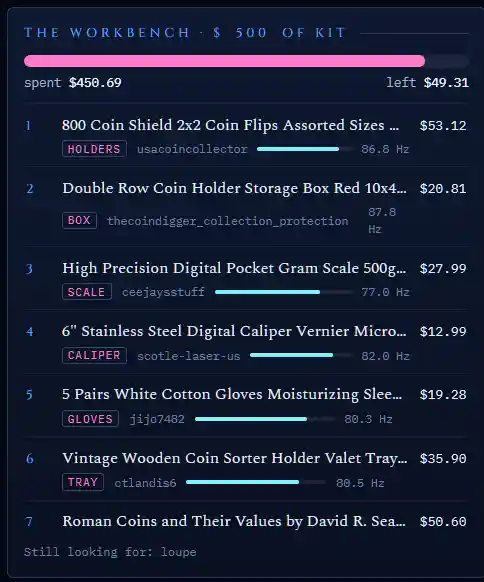
The equipment purse worked differently. The fly got one item of each kind, in a set order, taking whichever had the most want and still fit. The cabinet came last, so it got whatever was left. It filled every slot except the loupe. No loupe listing got past my filter, probably because it threw out any title containing "jewel", and loupes are often sold as "jeweler's loupes".
Kind | Item | Seller | Price | Want |
|---|---|---|---|---|
holders | 800 Coin Shield 2x2 Coin Flips Assorted Sizes Mylar Cardboard Holders PVC Free | usacoincollector | $53.12 | 86.8 Hz |
box | Double Row Coin Holder Storage Box Red 10x4x2 for 2x2 Flip Snap Case Guardhouse | thecoindigger_collection_protection | $20.81 | 87.8 Hz |
scale | High Precision Digital Pocket Gram Scale 500g x 0.01g with Tare Function | ceejaysstuff | $27.99 | 77.0 Hz |
caliper | 6" Stainless Steel Digital Caliper Vernier Micrometer Measuring Ruler US Ship | scotle-laser-us | $12.99 | 82.0 Hz |
gloves | 5 Pairs White Cotton Gloves Moisturizing Sleeping Coin Handling Inspection Soft | jijo7482 | $19.28 | 80.2 Hz |
tray | Vintage Wooden Coin Sorter Holder Valet Tray Felt Lined EUC 4.5 x5.5 x4.5 (057) | ctlandis6 | $35.90 | 80.5 Hz |
book | Roman Coins and Their Values by David R. Sear 1988 4th Edition (1994 Reprint) | experienceserenity | $50.60 | 86.8 Hz |
cabinet | Coin Cabinet Wood with 5 Red Trays MasterPhil Handmade in Italy | coinsmore | $230.00 | 86.5 Hz |
The eight items came to $450.69 of the $500. The fly chose the $230 handmade Italian cabinet over three cheaper ones it had held. Its book was Sear's Roman Coins and Their Values, a standard price guide for Roman coins and the one I would have picked too. The wooden valet tray (a dish for pocket change) is not really a coin tray, but I'll allow it.
The dream list
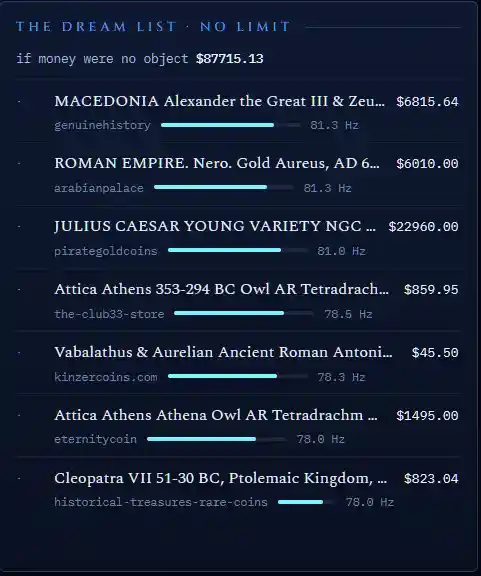
The dream list is what the fly wanted most with no budget. It shows the twelve coins with the highest want that weren't in the cabinet, at any price, including coins up for auction.
Together they come to $87,715.13. The top three were an Alexander the Great tetradrachm, a Nero aureus (a Roman gold coin) and a Julius Caesar aureus at $22,960. All three got about 81 Hz, the most want any coin got. Their titles name famous rulers and grading certificates, and the Nero and Caesar coins are gold, which my rules score highly. Luck played a part too. The same seller listed a second Julius Caesar aureus with an identical title, and it got only 74.75 Hz.
The list is ranked by want alone, so a well-described cheap coin can sit next to a $25,000 one. Three made it: a $45.50 Vabalathus and Aurelian antoninianus (a very well-described coin of a very unusual pair of rulers), an $89 Constantius Gallus bronze and a $14 coin in a Heritage auction (a $5 bid plus estimated fees and shipping).
What I'd change
Feed the brain more than one number. Everything about a coin was squeezed into a single sugar signal, but the fly's brain also has inputs for smell, sight and touch. Price could go into a signal the fly dislikes, like bitter taste, and quality into sugar. Then the fly's own wiring could do some of the weighing, instead of leaving it all to the program that fits coins into the budget.
Look at the pictures. Reading only titles is why the replicas got in. The next version should have Claude look at each photo and judge the coin's condition, and whether it looks genuine, before my rules score it.
Ask a dealer. I'd love to hand the final list to a professional and see what they'd keep.
Run two, silver only, and this time I'm buying
I'm running the experiment again, and this time I will buy the coins the fly picks. It's all set up and running: it started on the evening of September 22 and ends on the evening of September 28. None of the fixes in my list above are in it yet, because I only changed what the fly is shopping for.
The new rules:
A $500 budget for at most 10 coins, and fewer is fine, because this time it's about the quality of the coins, not the amount. Each coin must cost at least $50, shipping included.
Silver only, Greek or Roman. The title has to say silver or AR (from argentum, Latin for silver), or name a silver coin such as a Roman denarius or a Greek drachm. Billon, a low-grade silver, is out. So are plated coins and fourrées, ancient fakes with a thin silver skin over a cheap metal core.
Quality matters more this time. My rules look for the dealer's grade in the title. Grades rate condition: EF (extremely fine) is near the top, and VF (very fine) is one step below. The grade makes up 40% of a coin's score. Any flaw the dealer mentions, such as porous, corroded or holed, pulls the grade down whatever else the title says. Fame counts for less than before.
VCoins is the main source, because its dealers usually put a grade in the title. Claude searches it every three hours, checks eBay once a day, and visits five other dealer or auction sites from my list each time.
There's still a dream list, but no equipment budget this time.
The fly still only reads titles, so a dealer who overstates a coin's grade gets rewarded. A coin with no grade in its title scores lower than one marked VF. I'll check every coin and seller myself before I pay. When the run ends, I'll post what the fly picked and what I bought.
Try it yourself
The code is open source at github.com/bth0mp/fly-brain-collector. It downloads the brain model from the authors' repository and comes with five collecting themes: ancient coins, classic US coins, world banknotes, Pokémon cards and fossils. Only the ancient coins theme has had a live run. The others pass their self-checks but have never met a live listing. You need a Windows PC with about 16 GB of free RAM, the Claude desktop app to do the browsing, and a C++ compiler (free software that lets the simulator run at full speed). The code never buys anything.
Before you buy anything from these lists, keep in mind that nothing here is authenticated. My rules read only titles, and as the replicas showed, titles lie. Check every coin, seller and photo yourself. Several of these listings will have sold by the time you read this.
Brain model: Shiu et al., A Drosophila computational brain model reveals sensorimotor processing, Nature 634, 210–219 (2024), code at philshiu/Drosophila_brain_model. Connectome: FlyWire (Dorkenwald et al., Schlegel et al., Nature 2024). Simulator: Brian2. Run one: September 17 to 20:59 on September 22, 2026 (I stopped it early to start run two), 3,119 simulations, 19 logged errors, one of which needed a restart. Built with Claude Code.