Constantine, Sole Augustus: Imperial Propaganda, Vota style
We take a look at the Vota series initiated by Constantine after ascending to sole Emperor, and specifically a Londonium emission.
Historical Writeup/Research/Essay
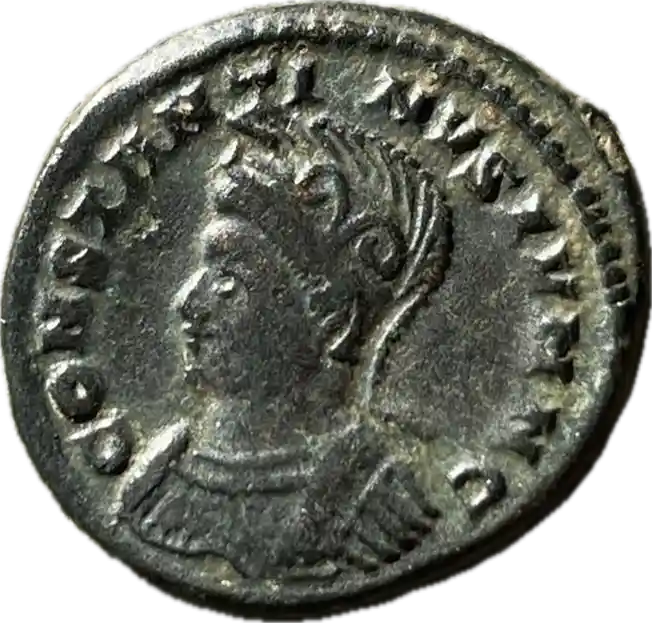
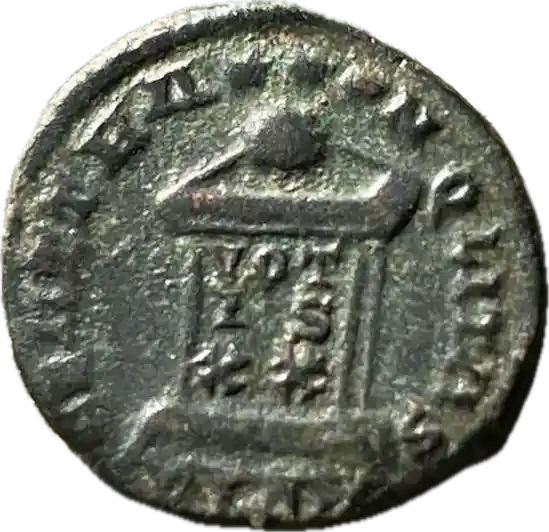
Constantine II (as Caesar, 317-337 AD), AE3 Follis, Londinium mint, struck 323-324 AD, 20mm, 3.6g, CONSTANT-INVS IVN NC, helmeted cuirassed bust left / BEATA TRANQVILLITAS globe on altar inscribed VOT/IS/XX in three lines; three stars above; PLON in exergue, RIC VII London 287; Cloke & Toone 11.02.008; Sear RCV III 17149
This coin emerges from one of the most triumphant yet propagandistic moments in Roman history: the years 323–324 AD, immediately after Constantine the Great’s decisive victory over his rival Licinius at Chrysopolis in September 324. With the empire finally reunited under a single ruler after decades of civil strife, Constantine moved swiftly to assert unchallenged authority and to secure his dynasty’s future. Following the loss of Illyrian silver mines to Constantine after the 317 settlement, Licinius had issued progressively smaller folles containing only trace amounts of silver; upon becoming sole emperor in 324, Constantine immediately demonetized Licinius’ coinage as it was essentially worthless, clearing the way for a unified and stabilized monetary system.
The Londinium mint, now fully under his control in the western provinces, launched a massive, highly standardised “post-reform” bronze series celebrating prospective vicennalia (20-year) vows. The inscription VOT/IS/XX on the altar boldly proclaims prayers for twenty years of rule—not yet achieved, but confidently anticipated. For Constantine himself (ruling since 306), these were genuine vicennalia vows; for his young sons, including Constantine II (the Caesar depicted here), they symbolised the promised longevity of the new Constantinian line.
The reverse design is rich with layered meaning: Tranquillitas, personified as “Blessed Peace” (BEATA TRANQVILLITAS), stands beside a globe-topped altar beneath three stars evoking cosmic harmony, divine favour, and the eternal order restored by Constantine’s sole rule. After years of bloody division, this imagery reassured the empire: peace had returned, ordained by the heavens, and the dynasty would endure.
Struck in vast quantities across multiple mints yet remarkably uniform in style, these coins served as powerful tools of imperial propaganda, broadcast from Britain to the eastern frontiers. In the hands of soldiers and citizens alike, they whispered a compelling message: the storms of civil war were over, and a stable, divinely sanctioned future lay ahead under Constantine and his heirs.
This type belongs to the principal post-reform vota series from Londinium, dated AD 323–324, commemorating prospective imperial vicennalia vows and dynastic stability following the defeat of Licinius. In Patrick M. Bruun’s framework for RIC Volume VII, it is catalogued as part of the consolidated Londinium emissions in this phase. In the specialised study by Hugh Cloke and Lee Toone (The London Mint of Constantius and Constantine, 2011), it corresponds to their Issue 11 (sub-series 02), specifically variant 11.02.008 or closely related, representing a single major emission without further internal subdivisions.
The reverse legend BEATA TRANQVILLITAS (“Blessed Tranquillity”) and the central motif of a globe resting upon an inscribed altar symbolising the orbis terrarum upheld by imperial vows explicitly invoke divine favour and cosmic harmony under Constantinian rule. The three stars above the altar are conventionally interpreted as celestial endorsement of the imperial family’s longevity and the renewal of vows (votis XX mult XX implied), a theme reinforced across multiple mints in the aftermath of the Second Civil War (AD 324). Production at Londinium during this period reflects the mint’s role in supplying the western provinces with propagandistic bronze coinage, with the helmeted, left-facing bust of Constantine II distinguishing his issues from those of his father and brothers within the same emission. The type is abundant in hoards from Britain and Gaul, underscoring its widespread circulation and the deliberate dissemination of dynastic messaging in the early years of sole rule.
Bibliography:
Bruun, Patrick M. “Constantinian Mint Policy and the Imperial Vota.” Nordisk Numismatisk Årsskrift(1954): 1–55.
Bruun, Patrick M. The Roman Imperial Coinage. Vol. 7, Constantine and Licinius, A.D. 313–337. London: Spink & Son, 1966.
Cloke, Hugh, and Lee Toone. The London Mint of Constantius and Constantine. London: Spink, 2011.
Odahl, Charles Matson. Constantine and the Christian Empire. 2nd ed. London: Routledge, 2004.
Online Coins of the Roman Empire (OCRE). “ric.7.lon.287.” American Numismatic Society. https://numismatics.org/ocre/id/ric.7.lon.287.
Stephenson, Paul. Constantine: Roman Emperor, Christian Victor. New York: Overlook Press, 2010.
Zosimus. New History (Historia Nova). Book 2. Translated by Ronald T. Ridley. Canberra: Australian Association for Byzantine Studies, 1982.
Zosimus. New History (Historia Nova). Book 2. Translated by Ronald T. Ridley. Canberra: Australian Association for Byzantine Studies, 1982.